Amy Winehouse’s father says the late singer was off drugs for three years, but she was in a continuous battle with alcohol — and believes that the way she was trying to detox may have killed her, according to an interview with Anderson Cooper that aired Monday. Mitch Winehouse says he suspects his daughter suffered a seizure and “there was nobody there to rescue her.” While no one knows for sure the exact circumstances of Winehouse's death, subtance abuse treatment experts say an alcohol detox can be more deadly than most people imagine. “While you’re withdrawing from other drugs, you may want to die, but alcohol detox is the only actual drug detox you can die from,” says Cyndie Dunkerson, clinical supervisor for Hope By the Sea, an alcohol and drug detox and rehabilitation center in San Juan Capistrano, Calif. Scoop: Winehouse family shares more details about Amy's death An estimated 15.2 million Americans battle alcohol abuse and addiction each year, according to the 2008 National Survey on Drug Use and Health. About 5 percent of untreated patients going through acute alcohol withdrawal have seizures, according to a report published in Alcohol Health & Research World. Between 5 and 25 percent of patients die who are going through the severest stage of alcohol withdrawal, delirium tremens (DT's), the report said. “The body just doesn’t handle getting off of it very well,” says Dunkerson. Of those who don’t survive detox, ”most people, if they are not dying from a gastrointestinal bleed, they die from a really bad grand mal seizure.” Advertise | AdChoices Mitch Winehouse told Cooper the troubled British singing sensation was taking Librium, a drug commonly used to help with an alcohol detox and decrease the chances of seizures and anxiety. Toxicology reports confirmed the presence of Librium in Winehouse's body at the time of her death. It’s not known whether Librium contributed to Winehouse’s death, but Dr. Philip Gilly, medical director of the Maplegrove Center at Henry Ford Health System in West Bloomfield, Mich., says a seizure can be caused after 24 hours of alcohol withdrawal or withdrawal from long-term use of the medication, part of a class of benzodiazepines which includes other prescription drugs such as Ativan, Klonopin, Xanax and Valium. Librium can become addictive and can cause medical issues such as dependence, agitation, disorientation, hypertension, anxiety and anorexia if it’s taken much longer than a week. In severe cases, seizures can occur during sudden Librium withdrawal. “If someone were going to have a benzo withdrawal seizure because of the Librium, it means they were taking it improperly,” Gilly says. “They were taking it longer and more than they would need for alcohol withdrawal. They would have to be taking it every day for more than a month or two.” Dunkerson explains that during alcohol withdrawal, the body goes through a series of physical and neurological changes, and a simple hangover is a mild form of alcohol withdrawal. If drinking alcohol helps people relax and go to sleep, withdrawal causes the opposite of that. “Your blood pressure gets really high. You’ll get agitated, hyperactive, anxiety-filled and you will actually get depressed because of all that’s going on," she said. "You can get jaundice and turn yellow from hepatitis inflammation in your liver, and have hallucinations and seizures.” Drugs and alcohol affect the brain, says Gilly, and seizures are a short circuit in the brain’s electrical circuits. The brain goes through changes when a person starts taking drugs, or comes off them, causing overactive or irritated nerves that can lead to seizures. Mitch Winehouse said doctors warned his daughter to slowly cut down on drinking, but she didn’t. Dunkerson says that’s exactly what she tells incoming patients who call to say they are going to stop drinking before they arrive for detox. Alcohol withdrawal requires careful monitoring and taking a drug such as Librium to help. “You need medication assistance in getting through this. Otherwise, you are putting yourself at grave risk,” she says. “Nobody should ever try to quit drinking alcohol on their own if they have been a daily drinker for an extended period of time. My advice is ‘Don’t stop drinking until you get here.’ Get medical attention immediately because between 48 and 72 hours is when you have seizures from an acute withdrawal.” Alcohol withdrawal, which also can include tremors the first day, seizures and delirium tremens (DTs) within a week, doesn’t have to be deadly, but too often it is, says Dunkerson. “When I heard the news of Amy Winehouse’s death, I cried because she was such a tortured soul,” she says. “This disease doesn’t have to be fatal, but it is very, very fatal. The only thing I love about my job is getting people to walk out from the dead. The thing I hate about my job is I get to bury the people that don’t make it.”
.png)



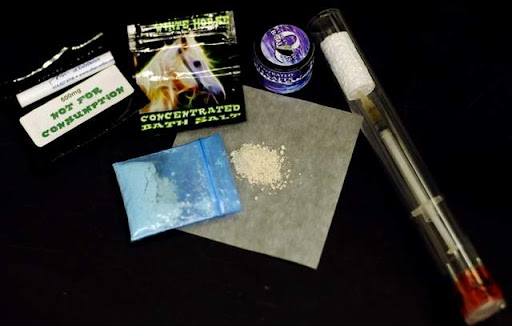 Middlesex County Prosecutor's Office has announced that three smoke shops in New Brunswick and a gas station in East Brunswick were raided and charged in the sale of illegal drugs. According to the Prosecutor's Office, the raids began on Aug. 2 after four months of investigative work and netted the following arrests: Jarnail Sandhu, 25, of Sayreville, owner of the Shell gas station located at 1010 Route 18 in East Brunswick, was arrested and charged with distribution of bath salts and synthetic marijuana; possession of bath salts and synthetic marijuana and possession of drug paraphernalia. He was jailed with bail set at $100,000, with no 10 percent option. Sandhu's mother, Charanjit K. Sandhu, 56, of Nanuet, N.Y., was also arrested and released on her own recognizance. She faces the same charges as her son. Ayman S. Al-Nsairat, 40, of East Brunswick, owner of the Amsterdam Smoke Shop, 29 Easton Ave. in New Brunswick. He was charged with possession of toxic chemicals and possession of drug paraphernalia, and was released on his own recognizance. Maria M. Almanzar, 20, of Union City at the Amsterdam Smoke Shop. She was charged with possession of toxic chemicals and possession of drug paraphernalia, and distribution of toxic chemicals, and was released on her own recognizance. Lukasz M. Poplawski, 21, of Staten Island, N.Y. at the Amsterdam Smoke Shop. He was charged with possession of toxic chemicals and possession of drug paraphernalia, and distribution of toxic chemicals, and was released on his own recognizance. Ranmanjeet K. Dhillon, 24, of Woodbridge, at the Jamaican Discount Smoke Shop at 38-A Easton Ave. in New Brunswick. Dhillon was charged with possession and distribution of toxic chemicals and possession of drug paraphernalia, and was released on her own recognizance. Additionally, the Jamaican Smoke Shop at 40 Easton Ave. in New Brunswick was also raided, and "Some illegal substances and drug paraphernalia were seized," according to the Prosecutor's office. No arrests were made at that location. Bath Salts are mix of chemicals that mimic the effects of cocaine and methamphetamines and were banned earlier this year. 6,547 bags, jars and vials containing synthetic marijuana and bath salts were also seized by police during the investigation, marked for sale for between $20 to $30 each, according to the Prosecutor's Office. Police also seized 2,914 pipes, bongs and hookahs, 193 digital scales, 357 canisters containing nitrous oxide, 13 imitation handguns used to fire blanks, and 46 containers designed to conceal illicit drugs, according to the Prosecutor's Office. Packaging material, grinders, cigars and rolling papers, "All identified as products used to prepare and help sell the illicit drugs," according to the Prosecutor's Office. $25,145 in cash from the sales of the illegal drugs was also seized. More than $163,000 in synthetic Marijuana and bath salts were seized. Members of the Middlesex County Prosecutor’s Gangs, Guns and Drugs Task Force are handling the investigation, assisted by police in New Brunswick, East Brunswick and Sayreville, according to the Prosecutor's Office
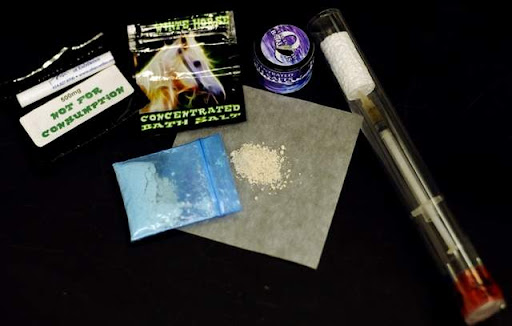 The U.S Drug Enforcement Agency's war on drugs continues with a nationwide ban of synthetic cocaine. Labeled as bath salts, the hallucinogenic drug has become more available in the Grand Junction area as part of a trend seen across the country. In response to increased emergency room visits, the federal agency has moved to emergency control these synthetic stimulants. This action makes it illegal to possess or sell Mephedrone, Methylenedioxypyrovalerone (MDPV), and Methylone or any products containing them for the next year. These chemicals are most often found in forms of 'legal ecstasy' or 'legal cocaine.' During the temporary ban, the DEA will team up with the U.S. Department of Health and Human Services to further study whether these chemicals should be permanently banned. In June, we introduced you to these bath salts in this article. Back then, they were an unregulated drug taking the place of recently banned synthetic forms of marijuana. "It is actually like a synthetic cocaine slash methamphetamine," Jim Schrant with the DEA told us at the time. "So, it's really the worst of both." The bath salts sell at a price of $40 per gram. They are mainly sold at smoke shops. But, in June, Schrant told us that his agency could not find any local dealers. Today, there are at least two. "They're putting it into packaging which is pleasing to the eye with market names of "Blue Dreams," things like that," Schrant said. "And, they're intentionally trying to target that young adult crowd." As part of this emergency control, businesses and citizens have 30 days to get rid of the banned products. At that time, the DEA will publish a Final Order in the Federal Register making the drugs Scheduled 1 substances. That category is the harshest and is reserved for unsafe, highly abused chemicals with no known medical use in the U.S. Violating that law is punishable by jail time. Employees at smoke shops in the area tell us that synthetic cocaine isn't that popular. But, local high school students have heard all about it. "I don't think they care if it's legal," Grand Junction High School freshman Hannah Rady said of some of her classmates. "Nobody does." Just like K2 and Spice, bath salts are labeled "not for human consumption." But, these students say that is not stopping anyone and neither is the law. "People just ask me 'Have you done spice before?' I'm just like, 'No,'" GJHS freshman Emilio Lazcano said. He knows Governor John Hickenlooper made those forms of synthetic marijuana illegal starting July 1, but he says fellow classmates continue to tell bother about it. "They're like 'Oh, well you're supposed to smoke it like this and that,' and I'm like 'Oh, well cool. I'm not really into that stuff.'" "They tell us that it doesn't make their eyes red, so it's way easier to bypass by your parents," GJHS junior Joe Gedscad added. The most common symptoms of these synthetic stimulants include impaired perception, reduced motor control, disorientation, extreme paranoia, and violent episodes. The DEA says the long-term physical and psychological effects are not known but potentially severe. Including Colorado, 33 states have already taken action to control or ban other synthetic stimulants. Most states pass these laws after the DEA files an emergency control on certain chemicals.
 Amy Winehouse's father says he believes she died after suffering a seizure related to alcohol detoxification and "there was nobody there to rescue her." The soul diva, who had fought drug and alcohol problems for years, was found dead in bed at her London home on July 23. Her family says toxicology reports indicated there was alcohol in her bloodstream but it was unclear whether this had contributed to her death at age 27. Mitch Winehouse said Friday during a taping of Anderson Cooper's new syndicated talk show that traces of the prescription drug Librium, which is used to fight anxiety and withdrawal symptoms of alcoholism, were found in her body. "Everything Amy did, she did to excess," he said on the show, which is to air as Cooper's debut Monday. "She drank to excess and did detox to excess." He said he regretted that his daughter — whose most famous song, "Rehab," has her answering "no, no, no" when told to go to rehab — was trying to kick her alcoholism without a doctor's help. He said "the periods of abstinence were becoming longer, and the periods of drinking were becoming shorter. It was heading in the right direction." The singer, whose other hits include "Tears Dry on Their Own," had suffered seizures during this period and would lose consciousness. Her father admitted he was speculating that this happened on the morning she died and said he should find out more conclusively how she died when a full inquest into her death begins next month. Years earlier, when Amy Winehouse was on harder drugs including heroin and cocaine, her father said, he would not have been surprised if she had died. Mitch Winehouse, who is starting his own singing career, was in New York when his daughter's security guard called him in July. Hearing the distraught tone of the security guard's voice, the father said his first words were, "Is she dead?" Amy Winehouse's breakthrough "Back to Black" album was recently certified as the best-selling disc in Britain so far during the 21st century. The updated take on old-time soul also was responsible for five Grammy Awards. "When she wasn't drinking," her father said, "she was absolutely on top of the world." He occasionally dabbed tears from his eyes as Cooper's show ran video clips of her. He said he was comforted by the outpouring of support from her fans. Her mother, Janis Winehouse, said she's had people approach her to thank her for having the singer. Mitch Winehouse said he blamed the singer's ex-husband, a music industry hanger-on, for introducing her to hard drugs but did not blame him for her death. He said she had not taken drugs since December 2008. Amy Winehouse's boyfriend at the time of her death, Reg Traviss, said they had spent a quiet evening looking at pictures and watching DVDs two days before she died. They were looking forward to attending a friend's wedding in a few days and were planning a trip to St. Lucia around her Sept. 14 birthday. He said he struggled to find the right moments to talk to his girlfriend about her drinking without seeming as though he was nagging. "She was a really clever girl," Traviss said. "She knew what she was doing. I would sometimes choose my moments when there was something that was needed to be said." Winehouse's family has set up a foundation to raise money to help people beat alcohol and drug addiction. Her father met with British political leaders to seek backing for setting up a drug rehab center in her name. The foundation officially starts operation next week, and her father indicated that was why he was coming forth to do interviews about her. Cooper's program donated $50,000 to the foundation, although spokeswoman Laura Mandel said the donation was made after the interview was set up and the booking wasn't contingent upon giving the foundation money. Amy Winehouse's stepmother and aunt also appeared on Cooper's show.
 Amy Winehouse's fortune was worth just over £2 million when she died. Although the late singer made The Sunday Times Rich List in 2008 with an estimated fortune of £10 million, the accounts for two companies she owned that were published yesterday suggested her financial value had decreased in the last several years. The figures showed that Winehouse’s Cherry Westfield company was worth £2,004,963 at the end of last November, which is £20,000 less than it was valued at in 2009. Her CW Touring company, meanwhile, dropped in value from £142,012 to £8,032 during the same period. Amy Winehouse’s ‘Back To Black’ becomes UK’s biggest-selling album of the 21st centuryMark Ronson toasts Amy Winehouse at his weddingDrug overdose ruled out as cause of Amy Winehouse's death According to The Daily Star, a source close to Winehouse claimed that she had spent thousands of pounds on drink and drugs. They said: Even though Amy spent thousands on drink, drugs and hangers-on, she was still a rich young woman. Had she beaten her issues with drink, she would almost certainly have lived a worry-free and comfortable life. It is sad that having beaten drugs, she never got a chance to enjoy the money she worked so hard to produce.


0 comments:
Post a Comment